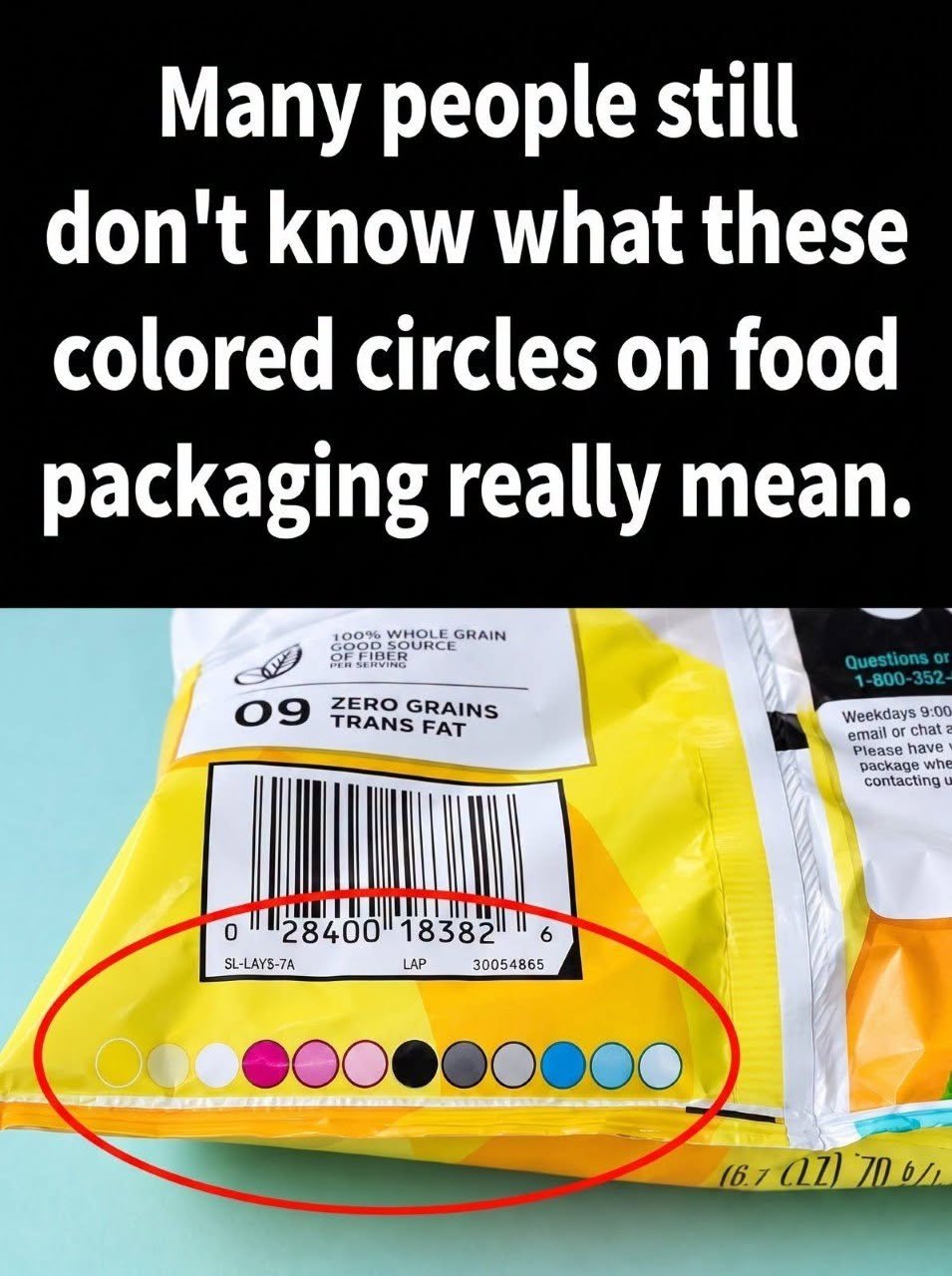
Why Are There Sometimes Several Different Colors?
This is where the marks can look especially mysterious.
You might see several colored circles or squares grouped together.
Those colors can correspond to inks used in the printing process.
Many commercial printing processes use a combination of basic ink colors to reproduce a huge range of colors on packaging.
A familiar example is the CMYK color system:
C = Cyan
M = Magenta
Y = Yellow
K = Black
Depending on the printing process and the package design, additional colors or specialty inks may also be used.
The exact arrangement isn’t necessarily the same on every package.
Some packaging may have only a few color marks, while other designs can contain a larger selection.
Why Are They Usually Near the Bottom or Edge?
There’s a practical reason you often find these marks in an out-of-the-way location.
They’re primarily intended for the people involved in printing and manufacturing.
There’s no reason for a brand to make these technical marks a prominent part of the package design.
So they’re often placed along an edge, near the bottom, or in another area where they won’t interfere with the main artwork, nutritional information, or branding.
That also explains why you may have looked at hundreds of packages without ever really noticing them.
They’re there.
They’re just not meant to grab your attention.
What Do Printing Technicians Look For?
Color control marks can help technicians evaluate whether the printing process is producing consistent results.
They may check things such as:
Color consistency
Is the ink producing the expected color?
Ink density
Is enough ink being applied to create the intended appearance?
Registration
Are the different layers of ink lining up properly?
Print quality
Are there problems with the press, ink application, or other aspects of production?
These checks help maintain consistency throughout a print run.
And when you’re producing thousands or millions of packages, consistency becomes extremely important.
What Happens If the Colors Aren’t Right?
If a technician notices that a color isn’t matching the expected standard, adjustments can be made during production.
Depending on the printing process, that could involve changing ink levels, correcting registration, adjusting the press, or addressing another printing issue.
The idea is to catch problems before a large quantity of packaging is produced with noticeable color differences.
So those tiny circles can serve as a surprisingly useful quality-control checkpoint.
Do All Food Packages Have Them?
No.
You won’t necessarily find printer’s color blocks on every food package.
Their appearance depends on factors such as the printing method, packaging material, printer, artwork, and production process.
Some packages may use different kinds of registration or quality-control marks, while others may have marks that aren’t as obvious.
So don’t be surprised if you inspect your pantry and find some packages with colorful blocks and others without them.
What About the Little Numbers and Lines You Sometimes See?
You may also notice other tiny marks, numbers, bars, symbols, or patterns on packaging.
These can have different purposes.
Some may relate to printing registration or color control. Others can be production marks, codes, cutting guides, or other information used during manufacturing.
That’s why it’s best not to assume that every tiny symbol on a package means the same thing.
Packaging is a surprisingly technical process!
Why Is Consistent Color So Important to Brands?
Here’s the part that makes the whole thing especially understandable.
Imagine walking into a grocery store and seeing your favorite brand’s packaging.
You probably recognize it before consciously reading the name.
That’s because colors, fonts, logos, illustrations, and overall package design all contribute to brand recognition.
A company wants its packaging to look consistent whether it is printed today, next month, or in another facility.
Color management helps make that possible.
Those tiny blocks may not mean anything to the average shopper, but to a printing technician, they can provide useful information about how the package is being produced.
Are Printer’s Color Blocks a Secret Food Safety Code?
No.
This is one of the biggest misconceptions worth clearing up.
If you see a row of colored circles on a package, don’t interpret them as a safety rating or food-quality scale.
They aren’t a hidden nutritional score.
They don’t tell you whether the food is safe to eat.
For food safety, pay attention to things that actually provide that information, including:
The expiration or best-by information
Proper storage instructions
The condition of the packaging
The ingredient list
Allergen information
Nutrition information
Recall notices when applicable
And always pay attention to damaged, leaking, swollen, or otherwise compromised packaging.
Why Did I Never Notice Them Before?
Probably because you weren’t looking for them!
We tend to focus on the information that’s most relevant when we’re shopping: the price, brand, ingredients, nutrition facts, flavor, and expiration date.
Tiny technical marks near the bottom of a package aren’t exactly designed to attract attention.
Once you know what they are, though, you’ll probably start spotting them everywhere.
And that’s one of those little facts that makes grocery shopping unexpectedly interesting.
Frequently Asked Questions
What are the colored circles on food packaging called?
They’re commonly referred to as printer’s color blocks, color control patches, or other types of printer’s marks.
Do the colored circles tell me if food is healthy?
No. They are generally related to the printing process rather than the nutritional quality of the food.
Do the colors indicate ingredients?
No. The colors aren’t generally a code for ingredients. Check the ingredient list on the package for that information.
Are the circles related to expiration dates?
No. Expiration, best-by, or use-by information is provided separately.
Why do some packages have more colors than others?
The number and type of color marks can vary depending on the printing process, artwork, inks, and packaging manufacturer.
What is CMYK printing?
CMYK stands for cyan, magenta, yellow, and black. These four ink colors are commonly combined in commercial printing to reproduce a wide range of colors.
Are these marks useful to consumers?
Not usually. Their primary purpose is to help printers and production teams monitor printing quality and color consistency.
Why are the marks near the edge of the package?
They’re generally positioned where they can be accessed or monitored during printing without interfering with the package’s main artwork and consumer-facing information.
The Bottom Line
Those mysterious little colored circles on food packaging aren’t a secret code about what’s inside your favorite snack.
They’re generally much less mysterious—and much more practical.
They’re part of the printing process.
Printer’s color blocks and related marks help printing professionals monitor things like ink colors, consistency, and print quality so that the packaging looks the way the brand intended.
So the next time you’re standing in the grocery aisle and notice a row of colorful circles hiding near the bottom of a package, you’ll know you’re looking at something designed primarily for the people behind the scenes.
And isn’t it funny how many little details we walk past every day without realizing there’s a story behind them?
Now that you know what those colorful marks are for, you might find yourself checking every package in your pantry.
Just don’t blame me when grocery shopping suddenly turns into a scavenger hunt!!
If you found this little packaging mystery interesting, share it with a friend or save it to Pinterest so they can discover what those strange colored circles really mean, too.
For Complete Cooking STEPS Please Head On Over To Next Page Or Open button (>)